Published
Why Do People Talk in Their Sleep?
A calm, evidence-aware look at what research does and does not explain about sleep talking.
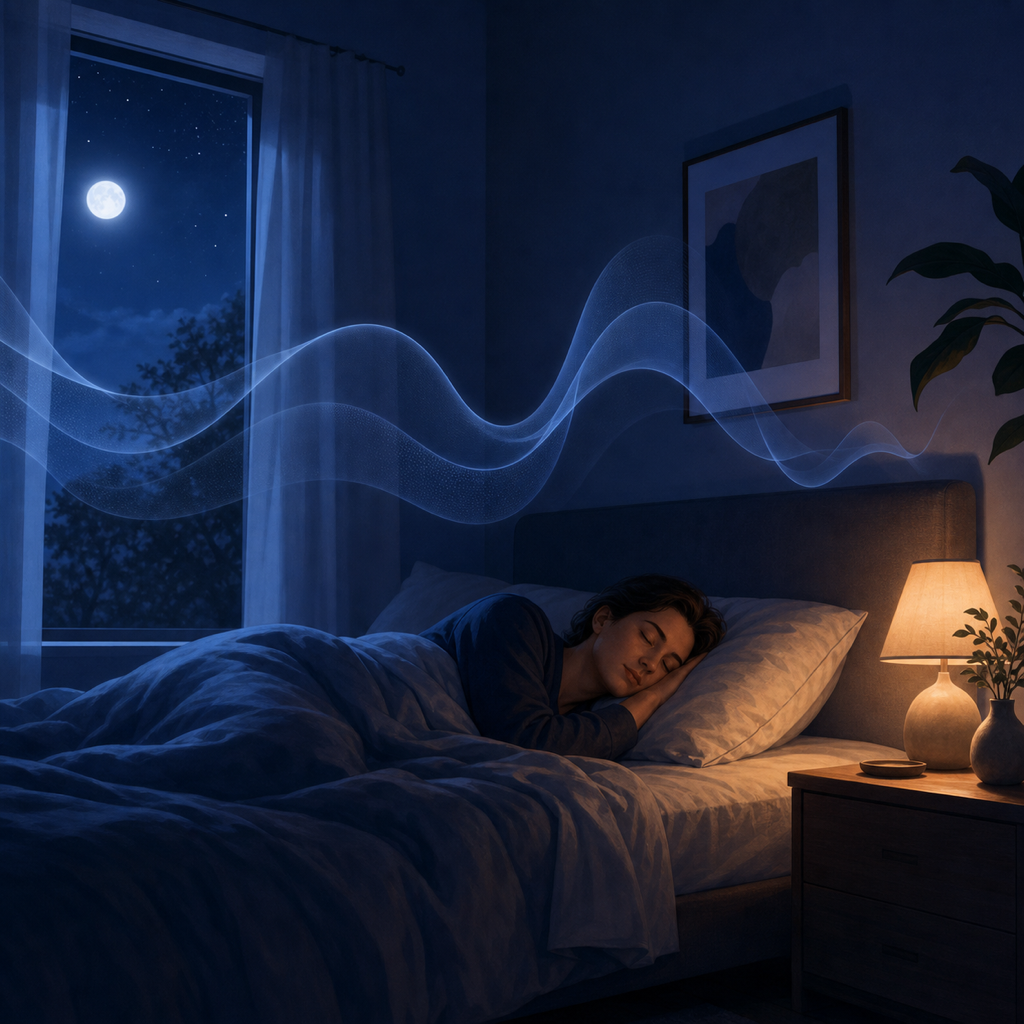
Why is sleep talking so hard to explain?
Sleep talking can be surprising to hear about the next morning. It may be a whisper, a few mumbled words, a laugh, a clear sentence, or something in between. For adults who are curious about their own nighttime sounds, the natural question is simple: why does it happen? The careful answer is less simple. Sleep talking can occur across sleep stages, but research has not established one single cause that explains every person or every audible moment. Some people notice it because someone nearby mentions it, while others only become curious after thinking back on an unusual night. Either way, the sound is a starting point for observation, not a complete account of the night.
That uncertainty matters. A spoken phrase can feel meaningful, especially if it seems unusually clear or emotional. Yet a moment of nighttime speech is still only one observation. It does not, by itself, reveal what was happening in the brain, what a person was experiencing, or why the speech occurred. Curiosity can begin with the sound, while leaving room for what the sound cannot answer. Research cannot turn a sentence into a reliable explanation.
What research can say, and what it cannot
The 2019 peer-reviewed review indexed by PubMed describes the literature on sleep talking as dated and fragmentary, despite growing knowledge about sleep and nighttime behavior more broadly. Its authors call for more systematic study. That does not mean nothing is known. It means the evidence does not yet support a neat, one-size-fits-all explanation of why a particular person talks on a particular night. Researchers must also account for differences in how nighttime speech is captured, described, and studied, making direct comparisons difficult.
Sleep itself changes through stages and cycles, rather than remaining one uniform state until morning. Sleep talking has been reported across sleep stages, including REM and non-REM sleep. That is helpful background, but it is not a shortcut for interpreting a sound. Hearing speech does not show which stage someone was in, and it cannot turn a phone’s microphone into a sleep-stage measure.
Possible contributors are not proven causes
Disrupted sleep patterns, stress, travel, and insufficient sleep are often discussed as possible contributors. They may coincide with sleep talking for some people, and they are reasonable details to notice when reflecting on a night. Still, possible contributor is not the same as proven cause. One busy week, one late bedtime, or one trip cannot establish why a particular audible moment happened.
Everyday nights contain many overlapping changes. Travel can bring a new room, unfamiliar sounds, a different schedule, and less sleep. Stress can overlap with changes in routine. People may also remember unusual nights more vividly than quiet ones. When two things occur together, the connection may be worth wondering about, but it does not establish that one caused the other. Research can point to questions without supplying a personal answer.
What a phone can and cannot show
A phone may help surface audible moments for personal review. That can make a vague memory more concrete: perhaps there was a brief voice-like sound, a laugh, or a noisy stretch of the night. Personal review can support simple questions such as, “What did I notice?” or “Do I want to pay attention to this over time?” It is a way to observe sound, not a way to explain it.
A phone cannot identify why speech occurred, determine what someone was thinking or dreaming, or measure sleep stages from sound. It cannot show that stress, travel, a disrupted routine, or insufficient sleep was responsible. Microphones also have ordinary limits: distance, placement, room noise, and phone settings all affect what is audible. A quiet result does not prove that nothing happened, just as one audible moment does not explain the whole night.
Staying calmly curious
A useful approach is to keep the question modest. Notice context if it feels relevant, but avoid turning one sound into a story with a certain ending. You might compare your own observations over time, make a plain note about a changed routine, or simply decide that a moment was interesting. The goal is not to label the experience. It is to leave space for attention, uncertainty, and ordinary human curiosity.
Sleep Talk is coming soon for adults who want a calmer way to notice their own nighttime sounds. It is intended to make audible moments easier to find and review personally, while being clear about what phone audio cannot tell you. It cannot identify why a sound occurred or measure sleep stages. Stay curious about your nighttime sounds and watch for Sleep Talk, coming soon.
Sources consulted
Cleveland Clinic, “Why Do People Talk in Their Sleep?” https://health.clevelandclinic.org/talking-in-your-sleep-heres-what-that-could-mean. Consulted for accessible general background; it does not provide a single explanation for an individual’s sleep talking.
PubMed, Alfonsi et al., “Sleep talking: A viable access to mental processes during sleep” (2019): https://pubmed.ncbi.nlm.nih.gov/30594004/. This peer-reviewed review describes the literature as incomplete and calls for further systematic research; it does not allow causes or sleep stages to be inferred from a person’s phone audio.